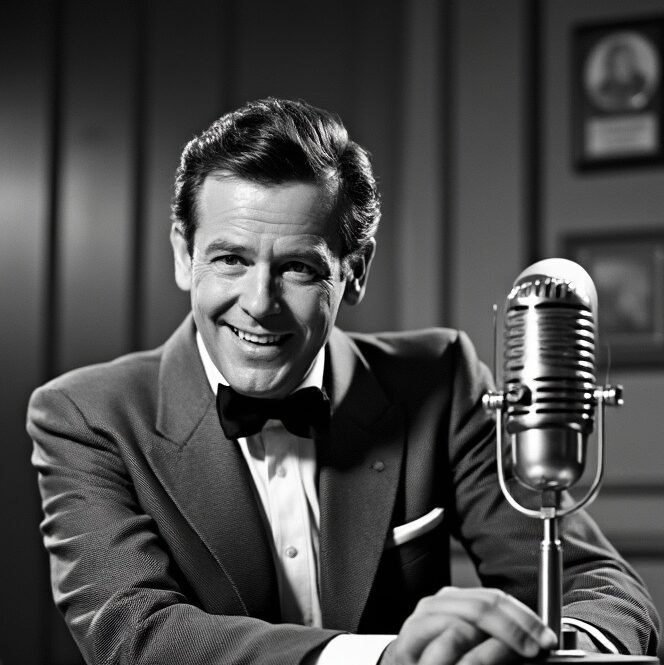
 Earl “Madman” Muntz was one of the most flamboyant, inventive, and larger-than-life American entrepreneurs of the 20th century. Born Earl William Muntz on January 3, 1914, in Elgin, Illinois, he was a self-taught tinkerer and engineer who dropped out of high school but showed early genius—he built his own radio at age 8.
Muntz started his career in the 1930s selling used cars, but he truly became a sensation after moving to Southern California. He pioneered wild, high-energy advertising with his “Madman” persona: wearing outrageous costumes (like Napoleon hats or animal skins), performing stunts, and plastering his name everywhere with slogans like “I wanna give ’em away, but my wife won’t let me!” His over-the-top commercials and billboards made him a local celebrity and one of LA’s biggest tourist attractions in the 1940s. He sold massive volumes of cars (including during WWII when new ones weren’t available) and reportedly made and lost fortunes multiple times.
 In the late 1940s, as television was emerging as the next big thing, Muntz spotted opportunity. TVs were expensive and complex, often costing hundreds of dollars with dozens of vacuum tubes. Drawing on his electronics interest (from his radio days), he bought existing sets, tore them apart, and began removing components one by one—asking, “Does it still work?” If yes, he’d strip more. This ruthless simplification process became known as “Muntzing”: stripping out non-essential parts to slash costs while keeping basic functionality.The result? Muntz TV, Inc. produced some of the first affordable black-and-white television sets. In the early 1950s, he sold models for under $100 (a breakthrough when most sets were far pricier), targeted at urban buyers with strong local signals. His sets included built-in antennas (handy when many apartments banned external ones) and he pioneered measuring screens diagonally (corner-to-corner) to make them sound bigger. He aggressively marketed them with his signature crazy style, using jingles like “There’s something about a Muntz TV” and claiming they’d “last for Muntz and Muntz” (a play on “months and months”).
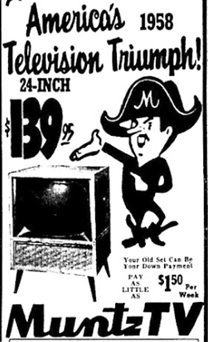 At its peak in 1952, Muntz TV grossed nearly $50 million (hundreds of millions in today’s dollars), competing head-on with giants like RCA, Philco, and Zenith. He popularized the abbreviation “TV” for television in his ads (though it had appeared earlier in some station call letters), and he even named his daughter Tee Vee Muntz.
Muntz TVs worked great in cities with strong signals but struggled in fringe areas due to the stripped-down circuits (fewer tubes meant less heat and better reliability in ideal conditions, but weaker amplification). Still, they democratized TV ownership, putting sets in middle-class homes years earlier than might have happened otherwise. The company faced challenges—overexpansion, competition, and financial issues—and Muntz TV went bankrupt around 1959. But Muntz bounced back as always. He later invented the Muntz Stereo-Pak “The Fidelipac” (a 4-track car tape player that inspired the famous 8-track format), dabbled in other ventures like his short-lived Muntz Jet sports car, and kept innovating until his death from lung cancer on June 21, 1987.
Earl “Madman” Muntz was a showman, a cost-cutting genius, and a pioneer who used sheer personality and bold engineering to make technology accessible—and entertaining. His legacy lives on in affordable consumer electronics, wild advertising, and the term “TV” itself.