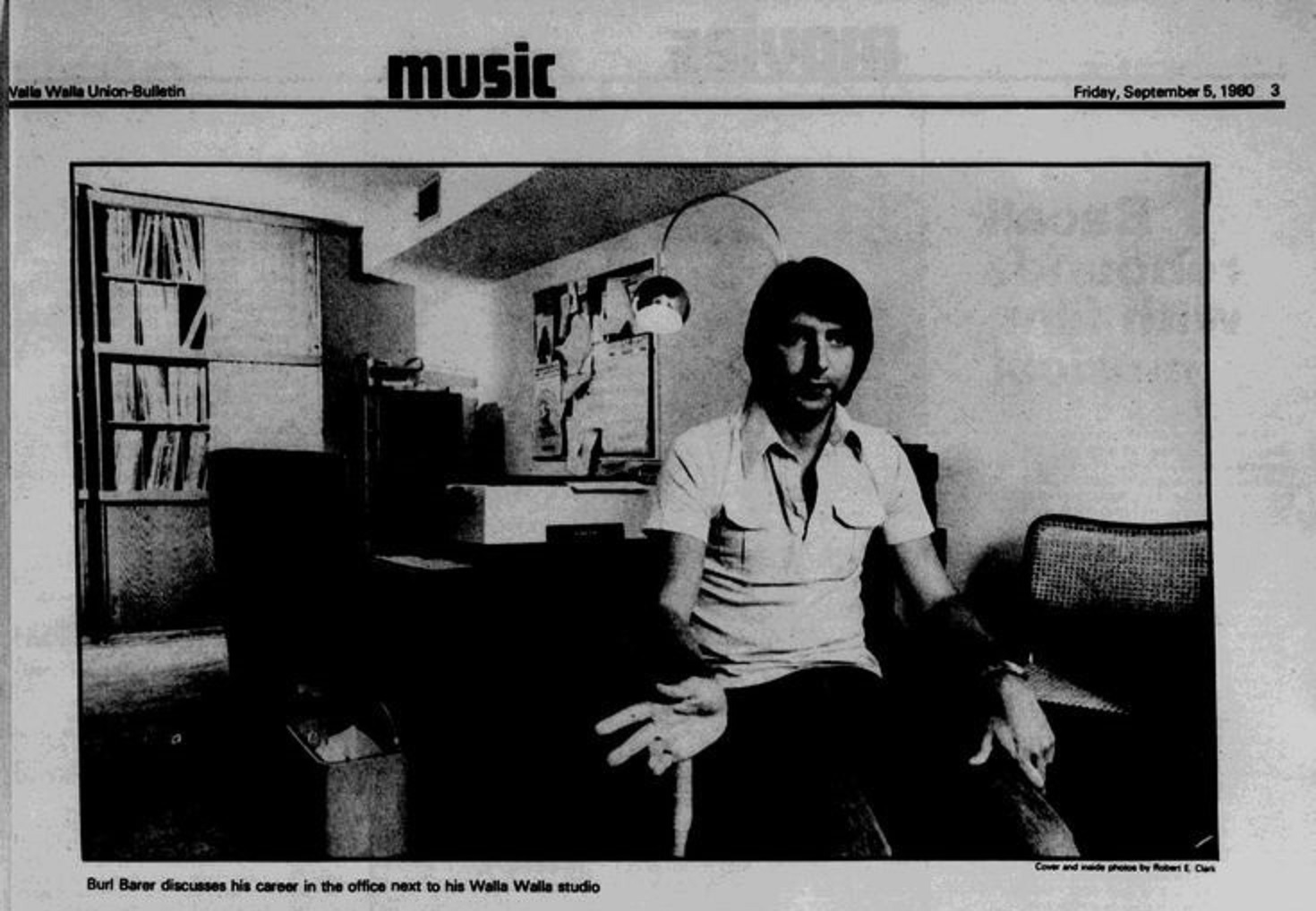
Born to rock ’n’ roll, raised on records, Burl Barer is back in town!
By STEVE MAYNARD Of the Union-Bulletin
Burl Barer spun out of Walla Walla in ’65, lured by a dream of radio stardom. Unlike most dreams, his soon came true.After graduating from Walla Walla High School that spring, Barer set all his hopes on his one ambition and moved to Seattle.“I wanted to be the highest-rated nighttime personality in that town,” the 33-year-old Barer recalled.
“I really wanted to play the hits in the big city.” Six years later, Barer had realized his rock ’n’ roll fantasy. He had climbed to the top as the No. 1 nighttime disc jockey in Seattle. He became known by his listeners as, “The legendary Burl Barer: raised on records, born to rock ’n’ roll.” The still slim-and-trim Barer has returned to his hometown for good. On the road back to Walla Walla, he passed up jobs in Seattle, Chicago and Los Angeles.
Instead, he decided to help run the family business, B. Barer and Sons — a steel supply and air products firm at 11 N. Fourth. Barer also still keeps his fingers close to the turntable at his Walla Walla studio, where he writes and produces radio commercials. His studio is well stocked with all the equipment needed to run a radio station, except for a transmitter.
Why did he really come back?
“I like Walla Walla — sue me!” he said with a laugh and with his hands raised for emphasis.He said he likes the climate here and believes the area is a good place for his family. He still travels frequently to Seattle and other cities like Los Angeles for radio work. He makes commercials in his studio for the John Bauer Concert Company, based in Bellevue. He’s made commercials for concert tours by Frank Sinatra, Alice Cooper, Sammy Davis Jr. and Bob Dylan — to name a few. By moving to Walla Walla, Barer also felt he could avoid a “vortex of materialism” that exists in the big city radio business.
As Barer quotes a fellow disc jockey: “There’s no such thing as the big time. There are only big cities.” But Barer didn’t feel that way when he moved to Seattle in 1963. He wanted his piece of the action in big-time Seattle radio. In those days, big time rock ’n’ roll in Seattle could be found at only one AM station — KJR. It wasn’t long before Barer got his break. He was taking classes at the University of Washington and landed a job working as an afternoon disc jockey for KYAC — a “soul” station that played mainly rhythm-and-blues music. Barer said he would wander down to KJR late at night to watch disc jockey “Big” Jim Martin, do his show during the “graveyard” shift. One night, Barer made his moonlight visit, only to find Martin on vacation. Another disc jockey was scheduled to fill in but wasn’t informed of the change. When the station found itself without a jock, Barer got his chance. The next morning, Barer was hired to work for a two-week stint. Not long after, he was assigned the 9-to-midnight shift at KJR. Barer later went on to work for another rock station, the now defunct KOL, in 1968. He returned to KJR in 1976 and later went to work for KYYX, a Seattle FM rock station. Barer proudly notes he was the top-rated nighttime disc jockey at three different times in Seattle: KOL in 1971, KJR in 1975 and KYYX in 1980. The rank is based on listener surveys.
The key to his radio success? Unlike many jocks, Barer said he didn’t rely on phony voices or prepared material. Instead, he performed in spur-of-the-moment fashion. And with a real name like Burl Barer, he never had to dream up a catchy name.
“The only character I ever did was Burl Barer,” he said. “The idea was that the whole show was like an inside joke in which the audience was on the inside.”
Barer gave an example of his smooth technique in an introduction on a single breath: “The legendary Burl Barer — born to rock ’n’ roll, I own this town at night…get on your knees and praise the day you discovered this station or I’ll come to your house and steal your furniture.”
Even today, Barer still spins the discs. He produces a 30-minute program of narration and rock music, relating the teachings of the Baha’i faith. Barer, an active Baha’i, says the show, available free of charge, circulates to 218 stations. He also works as a consultant for a local rock station KUJ. Sometimes, he fills in on the air.
“When I need a rock ’n’ roll fix, I drive out to KUJ. I play the hits and it feels good. I do love radio — there’s no doubt about that,” he said.
Jason Remington • January 15, 2023
Giving out the address was common for newspapers. Life/people were different then. We now live in a crazy world– gated communities for the common folk.
T.K. • January 17, 2023
I’ve heard of one person whose deceased mother’s home was burglarized after her address ran in a TNT obituary around 1980. Crime rings probably helped end the practice, at least in obituaries.
The papers seemed to stop doing it without much fanfare. More ink was spilled on discontinuing Mrs./Miss/Ms. before women’s last names on later references in an article. That actually got explained in editor’s columns and was gone by the late ’80s.
Jason Remington • January 17, 2023
If you remember the movie “Paper Moon”, Ryan O’Neal used addresses of the deceased published in the newspaper obituaries, in order to peddle his bibles to surviving family.
kjrol • February 3, 2021
Burl seemed to be satirizing the Boss Jock of the mid-1960s, with a wink to the radio audience. It was fun to listen to him
Jason Remington • February 6, 2021
I think you are spot on, kjrol.