On April 5, 1958 a navigation hazard was removed from Georga Strait… The hazard was known as “Ripple Rock”.
Named Ripple Rock in 1862 by Captain Richards because its peaks (just below the surface at low tide) created prominent standing waves (ripples) in the strong tidal flows.It became one of the most dangerous navigational hazards along the Inside Passage route (used by ships traveling between Vancouver/Vancouver Island and Alaska/northern ports). From the 1870s to 1958, it caused at least 119–120 ship incidents (over 20 large vessels and 100+ smaller ones damaged or sunk), claiming around 110–114 lives. One early high-profile incident was the 1875 wreck of the U.S. Navy steamer USS Saranac.
Efforts to remove it faced delays and opposition. A Marine Commission recommended action as early as 1931, authorized in 1942, but some Vancouver Island residents opposed destruction because they hoped to use the rock as a central support pillar for a proposed bridge or rail link connecting Vancouver Island to the mainland (via Bute Inlet or similar).
Early attempts (like surface drilling from a barge in the 1940s) failed due to the extreme currents breaking anchor lines constantly.The successful project began in the mid-1950s: Engineers dug a vertical shaft ~174 m (570 ft) down from nearby Maud Island, then a horizontal tunnel ~762 m (2,500 ft) underwater to beneath the peaks, followed by vertical shafts up into each peak, and a network of smaller “coyote” tunnels to place explosives.
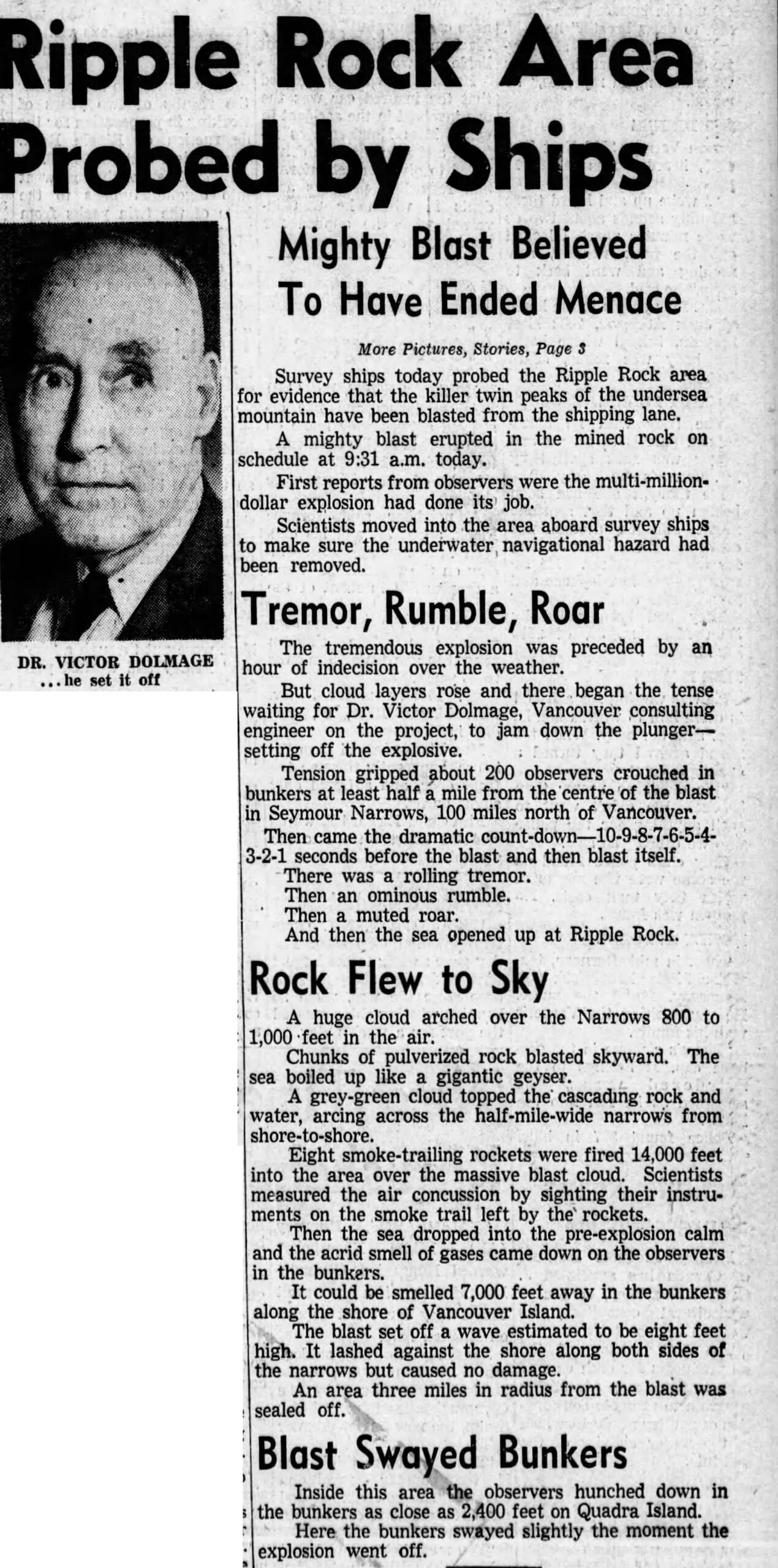
On April 5, 1958, at 9:31 a.m., the Canadian government detonated ~1,270–1,375 tonnes (about 2.75 million pounds) of Nitramex explosives in what was one of the largest non-nuclear controlled explosions ever (displacing ~635,000–700,000 tonnes of rock and water, with the plume reaching ~300–1,000 ft high). It was broadcast live on Canadian television. View CBC coverage below…
The blast removed the dangerous peaks (lowering the hazard significantly), making Seymour Narrows much safer for shipping. It’s remembered as a major engineering triumph and a key moment in BC maritime history.
This major event inspired a “Sea Hunt” episode. View below