 Ask someone who grew up in the 1960s, what the telephone number TH4-1111 was used for.
This was a recorded or operator-provided announcement giving the current time, typically updated every 10 seconds with a tone. The service was a standard Bell System offering in many areas, and the 844 prefix (corresponding to the letter exchange “TIme”) was used for it in the Seattle-Tacoma region. In Seattle directories and prefix lists from the era (post-1958 all-number dialing transition), it was explicitly linked to the “Time Teller Lady.” Tacoma, being in the same local calling area and under the same telephone company, shared this infrastructure.
It was a convenience we enjoyed, thanks to sweet Ma Bell. We got along just swell before the cell phone, Siri, Grok, and that annoying paper clip character. As Ogden Nash said, “Progress might have been all right once, but it has gone on too long.
So, in 1983, a judge ordered a halt to all this innovation and fabulous customer service by AT&T, Bell Labs and Western Electric.
More on that later.
The Bell System was a dominant “mutha giant” of telecommunication companies in North America from 1877 until its breakup in 1983.
Led by AT&T and known as “Ma Bell,” it provided local and long-distance telephone services, manufactured equipment via Western Electric, and performed research through Bell Labs. It was a vertical monopoly (AT&T, Western Electric, Bell Labs) providing comprehensive services.
It was for over 100 years the dominant phone service provider, setting standards in telephone technology.
Semiconductors & Electronics:
Transistor (1947): The point-contact transistor by John Bardeen and Walter Brattain (with William Shockley developing the junction transistor shortly after). This replaced vacuum tubes, enabled miniaturization, and is widely considered one of the most important inventions of the 20th century. Nobel Prize in Physics 1956.
MOSFET (Metal-Oxide-Semiconductor Field-Effect Transistor, 1959): By Dawon Kahng and Martin Atalla — the foundation of nearly all modern integrated circuits and microprocessors.
Solar Cell / Photovoltaic Cell (1954): The first practical silicon solar battery by Gerald Pearson, Calvin Fuller, and Daryl Chapin. It powered early satellites and launched the solar industry.
Computing & Software
UNIX Operating System (1969): Developed by Ken Thompson, Dennis Ritchie, and others. It became the foundation for Linux, macOS, and much of the internet’s infrastructure.
C Programming Language (1972) and C++ (1983): Created by Dennis Ritchie (C) and Bjarne Stroustrup (C++). These remain among the most influential languages in software development.
Error-Correcting Codes (1948): Richard Hamming’s work on reliable digital communication.
Information Theory (1948): Claude Shannon’s groundbreaking mathematical framework for data compression, transmission, and digital communication — the theoretical bedrock of the information age.
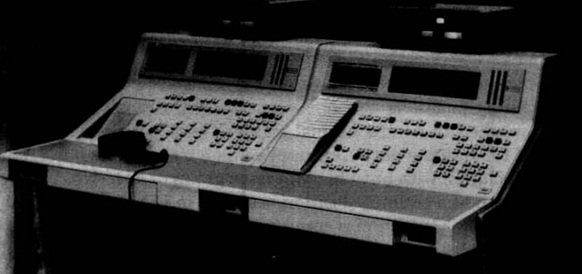
A large array of illuminated push-button keys for functions like coin collection, collect calls, person-to-person, billing, and routing
A numeric keypad
A headset jack
Indicator lamps and controls for handling toll/assisted calls with minimal manual intervention
This system automated much of the work previously done by plugging cords into a manual switchboard, allowing operators to handle calls more efficiently from centralized centers.
Optics & Imaging
Laser (1958–1960): Theoretical work by Charles Townes and Arthur Schawlow; first continuous gas laser by Ali Javan and others.
Lasers revolutionized communications, medicine, manufacturing, and more.
Charge-Coupled Device (CCD, 1969): Invented by Willard Boyle and George E. Smith. This enabled digital cameras, video, and astronomical imaging (e.g., Hubble telescope). Nobel Prize in Physics 2009.

Cellular Telephone Concept (1947): Early proposal for mobile networks using small cells and frequency reuse; later led to commercial cellular systems.
Telstar (1962): The first active communications satellite, which transmitted the first live TV signals across the Atlantic.
Fiber-Optic Communications: Major advances in optical fibers and systems, including the first commercial fiber-optic system (1977) and wavelength-division multiplexing foundations.
T1 Digital Transmission System (1962): Pioneering digital carrier system for voice and data.
Touch-Tone Dialing (1963) and Electronic Switching Systems (e.g., 1ESS in 1965): Modernized telephone networks.
Transatlantic Telephone Cable (TAT-1, 1956): First undersea cable for voice traffic.
Other Foundational Work
Radio Astronomy (1930s): Early observations that helped establish the field; Bell Labs researchers later contributed to the discovery of cosmic microwave background radiation (1964, Nobel Prize 1978).
Negative Feedback Amplifier (1927): By Harold Black — crucial for stable electronics and long-distance telephony.
Vocoder and Voder (1930s): Early speech synthesis and compression devices.
Stereophonic Sound (various advances in the 1930s): Transmission and recording techniques.
Horn-Reflector Microwave Antenna (1940s) and other microwave technologies.
Bell Labs researchers earned nine or more Nobel Prizes (depending on exact counting of shared work) and multiple Turing Awards. Their work spanned pure science (e.g., fractional quantum Hall effect), military applications during WWII (radar improvements, sonar), and practical telephony improvements that supported the growth of the Bell System.
Many inventions started as solutions to telephone network problems but had far broader impact — enabling the digital revolution, the internet, personal computing, and global connectivity. The labs’ culture of long-term, curiosity-driven research (combined with substantial funding from AT&T’s monopoly era) made this possible.
After the 1983 antitrust breakup, the 22 operating companies were organized into seven Regional Bell Operating Companies (RBOCs) or “Baby Bells,” including Ameritech, Bell Atlantic, BellSouth, NYNEX, Pacific Telesis, Southwestern Bell, and US West.
 (John Henry/New York Daily News, August 4, 1983)
The new AT&T bids Bell bye-bye
American Telephone & Telegraph Co. yesterday announced that it has accepted the last few court-proposed modifications for its reorganization—a move AT&T Chairman Charles Brown said “clears the decks” for the company’s Jan. 1 divestiture of its 22 operating companies.
At a news conference here, Brown said the communications giant had filed with Federal Court in Washington its agreement to changes in the reorganization plan made July 8 by Judge Harold H. Greene. The agreement included dropping the Bell System name and trademark that the corporation has used 107 years.
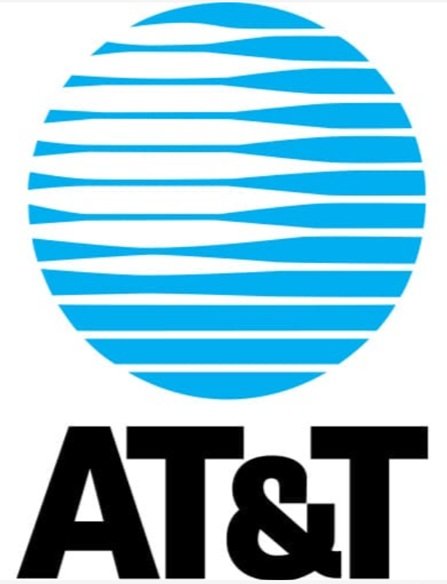
Brown said the company was “reluctantly” replacing the familiar Bell logo with a grid-lined globe to symbolize worldwide markets for high-technology electronic systems. The company’s official name will continue to be American Telephone & Telegraph, and the AT&T monogram will appear alongside the globe.
New AT&T logo.
LAST MONTH, Judge Greene, who has presided over the AT&T breakup stemming from the consent decree reached last year between the company and the Justice Department’s Antitrust Division, assigned the Bell name exclusively to the divested operating companies, Bell Laboratories and foreign subsidiaries of AT&T. The company will have to stop using the name American Bell for its new business information systems unit—a name Brown said AT&T had spent $30 million promoting.
SOON AFTER AT&T’s action yesterday, the Justice Department filed its acceptance of the modified reorganization plan with the court. Spokesmen said they expected Judge Greene to give final approval to the plan shortly.
**Author’s note: I started out at AT&T as a telephone operator, working with the new TSPS technology. I had one week in the cordboard office but did not enjoy that. At the time of the breakup in 1983, employees were given the opportunity to choose to stay with AT&T or move to the Pacific Northwest Bell offices, just as customers chose between AT&T for long distance service or one of the new companies, MCI and Sprint. As for the new AT&T logo, some employees called it ‘The Death Star.’ AT&T took great care of employees. Full health benefits, great pension plan and every employee received a turkey for Thanksgiving. Best company I have ever worked for! Tacoma, Seattle, Burien and Mesa, Arizona offices.
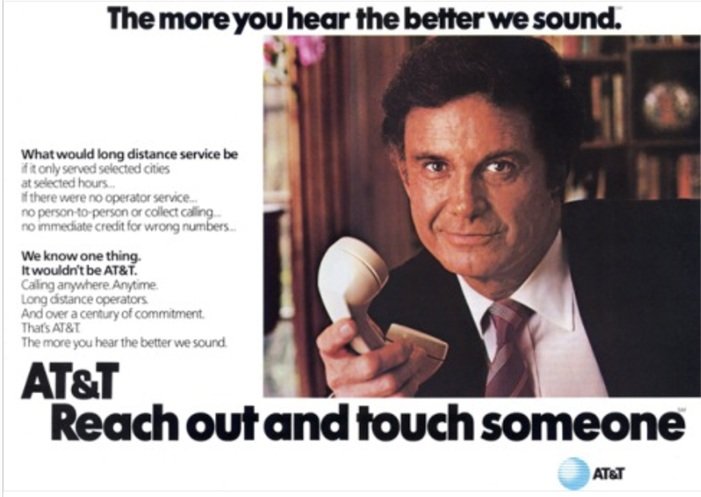


Re: Mah Bell
Steve • April 7, 2026
I still have a landline, Jason, and have no desire to get rid of it. If someone wants to reach me and I am not home, he can leave a message.
Landlines and VOIP
Jason Remington • April 7, 2026
The bad news is, phone companies have been phasing out legacy landlines—specifically the traditional analog service delivered over aging copper wires (known as Plain Old Telephone Service or POTS). This transition has been underway for years and is accelerating as of 2025–2026, driven by high maintenance costs, declining usage, and the shift to modern alternatives, such as VOIP (Voice Over Internet Protocol). When the power goes out — so will those phones.