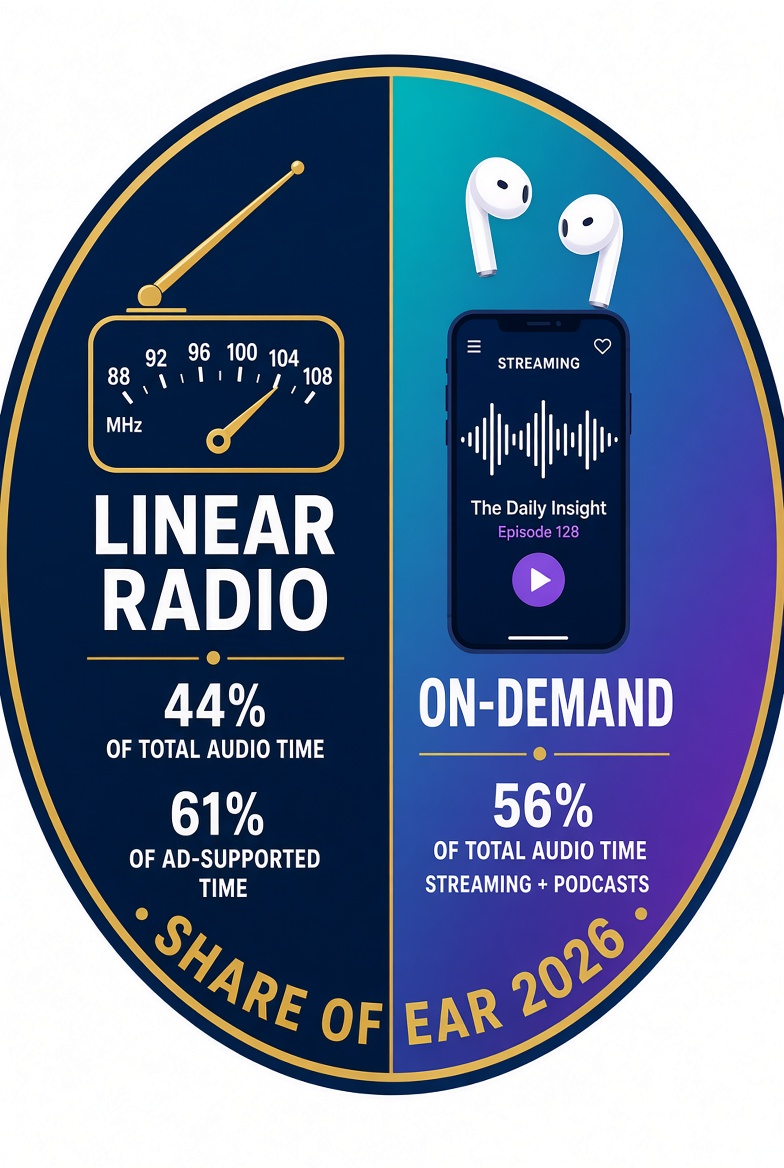
 On total time spent, on-demand now leads linear audio in the U.S.
Edison Research’s Share of Ear data for 2026 puts on-demand platforms—streaming music plus podcasts—at 56% of all audio listening time. Linear formats (AM/FM and satellite) hold the rest, a 12-point gap. The two sides first tied in 2023; linear had a 12-point lead as recently as 2020.
Broader listening picture
Americans average just under four hours of audio a day (about 3 hours 54 minutes in late 2025). Ad-supported audio is still the larger slice, about 63% of total listening in Q4 2025.
Within ad-supported audio (Edison / Nielsen, Q4 2025, similar in Q1 2026):
AM/FM radio (over-the-air plus station streams): about 61%
Podcasts: about 21%
Ad-supported streaming music: about 15–16%
Ad-supported satellite: about 3%
So radio plus podcasts still account for roughly 82% of ad-supported time. Paid, ad-free streaming is what tips the overall balance toward on-demand.
Reach vs. time
Streaming music’s daily music reach edged past AM/FM music in Q2 2026: 46% of Americans 13+ vs. 43% for radio or radio streams (Edison). In 2015 those figures were 27% and 61%.
Radio still leads overall daily reach among audio channels and monthly reach (Nielsen: about 93% of U.S. adults).
Online audio monthly listening is at a high of roughly 76–81% of people 12+ (Infinite Dial 2026). Among monthly online-audio users, Spotify leads (about 36%), then YouTube Music (about 34%).
Podcasts have overtaken AM/FM in spoken-word share of ear (about 40% vs. 39% in recent Edison data). Weekly podcast listening is around 40–45%.
Where linear still holds
In the car, AM/FM remains dominant: about 55% of all in-car audio time in Q1 2026, and about 83% of ad-supported in-car listening (near that level for a decade). Among 13–34s the device mix is shifting—mobile now slightly ahead of the built-in radio receiver for in-car time—but a large share of that mobile use is still station streams.