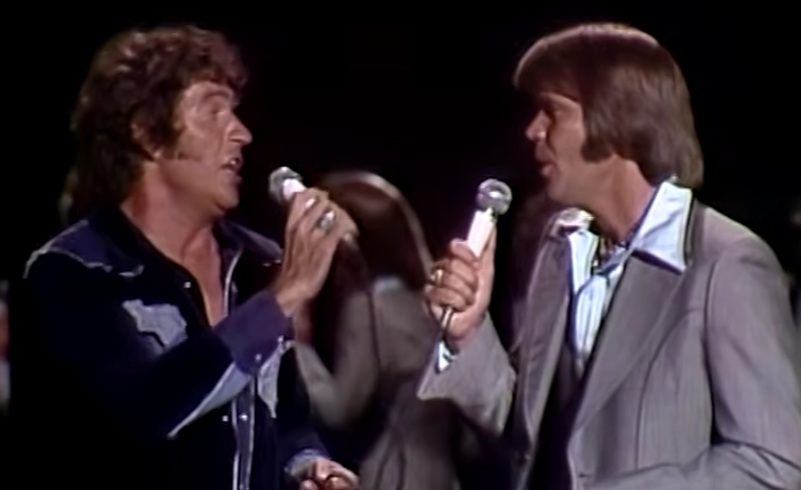
 Mac Davis’s second wife walked out the door and straight into Glen Campbell’s life.
Mac Davis and Glen Campbell were two Texas boys who both made it look easy until it wasn’t. Mac came out of Lubbock, the same dusty streets Buddy Holly had rolled down in a convertible. He started as the guy in the record-company office who wrote songs other people recorded. Then Elvis took “In the Ghetto” and “Don’t Cry Daddy,” and suddenly Mac wasn’t just the writer. In 1972 he stepped out front himself with “Baby Don’t Get Hooked on Me,” a sly little warning that topped the pop charts. He hosted his own TV show, played a swaggering quarterback in North Dallas Forty, and later surprised everybody by taking the lead in The Will Rogers Follies on Broadway. Mac Davis had that easy, self-deprecating grin that made people think he never took anything too seriously.
Glen Campbell came out of Delight, Arkansas, by way of every session band in Los Angeles. He was the guitarist who could play anything, then the singer who turned “Wichita Lineman,” “Galveston,” and “Rhinestone Cowboy” into American standards. For a few years in the late sixties and early seventies he was everywhere—television, movies, the cover of Time. He looked like the clean-cut country star who had it all figured out. He didn’t.
Mac’s first marriage had already ended. In 1971 he married Sarah Barg, who was barely out of her teens. They lasted five years. In 1976 she left him for Glen Campbell. The papers loved it. Two country stars, one woman, the kind of story Nashville and Hollywood both knew how to tell. Sarah and Glen had a son together. The marriage didn’t last long either; she left Campbell not long after the baby was born. Mac, looking back years later, said something dry and typical of him: “Obviously I was right.”
Mac kept writing and singing. He found Lise Gerard a few years later, married her in 1983, and stayed married until he died in 2020. Glen kept recording and touring, even after the Alzheimer’s diagnosis that eventually took him. The two men never became enemies in public. They just became another verse in the long country song about how fame and love don’t always stay in the same key. Mac wrote the songs. Glen sang the ones that made him a household name. And for a short, messy stretch in the mid-seventies, they both loved the same woman.